
Must-Track KPIs for Ecommerce Owners in Malaysia
ecommerce kpi indicators
What to Measure When Growth Starts Getting Expensive
- June 3, 2026
- Posted by: Weby Digital
- Category: Scaling Ecommerce in Malaysia

ecommerce kpi indicators
ecommerce kpi indicators
ecommerce kpi indicators
ecommerce kpi indicators
ecommerce kpi indicators
ecommerce kpi indicators
ecommerce kpi indicators
ecommerce kpi indicators
Why Most Ecommerce Dashboards Create False Confidence
Modern ecommerce platforms are generous with data. Revenue charts, traffic spikes, conversion percentages everything looks measurable. That’s precisely the problem.
When all metrics are treated as equally important, decision-making becomes reactive. Owners respond to drops and spikes without understanding what caused them. A dip in conversion triggers more ads. Slower growth triggers discounts. Rising refunds are blamed on customers.
In reality, most of these issues are downstream effects, not root causes.
KPIs are not meant to describe what happened.
They exist to explain why it happened, and what will happen next.
This distinction becomes critical once traffic increases and systems are under pressure.
Why Most Ecommerce Dashboards Create False Confidence
Modern ecommerce platforms are generous with data. Revenue charts, traffic spikes, conversion percentages everything looks measurable. That’s precisely the problem.
When all metrics are treated as equally important, decision-making becomes reactive. Owners respond to drops and spikes without understanding what caused them. A dip in conversion triggers more ads. Slower growth triggers discounts. Rising refunds are blamed on customers.
In reality, most of these issues are downstream effects, not root causes.
KPIs are not meant to describe what happened.
They exist to explain why it happened, and what will happen next.
This distinction becomes critical once traffic increases and systems are under pressure (#6 How To Handle High Traffic / Scaling Ecommerce Without Crashing).
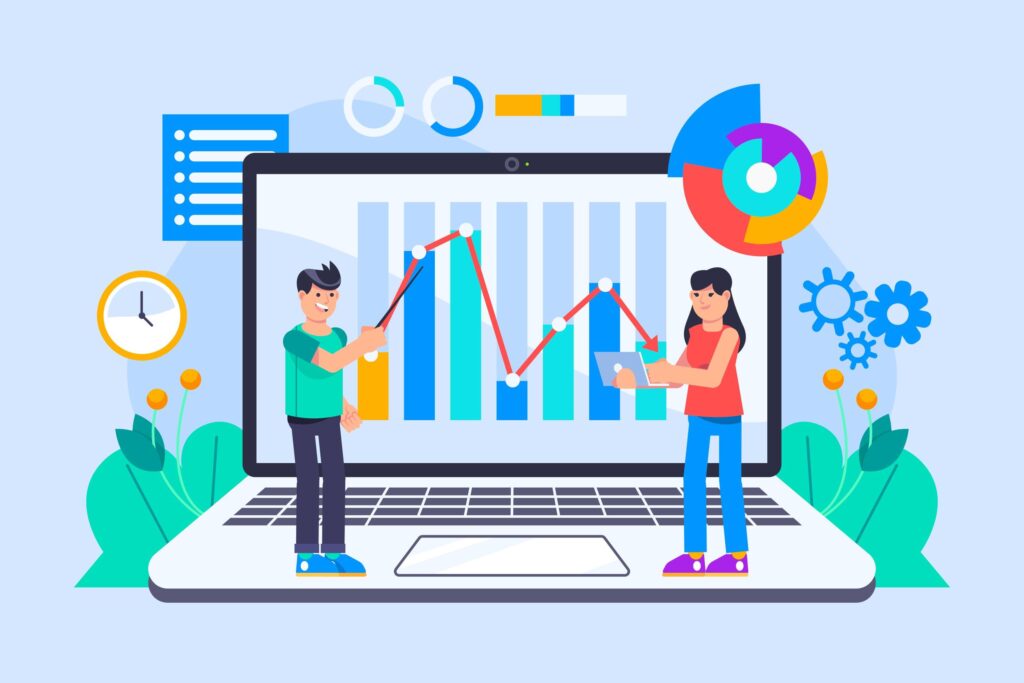
The KPI Stack: A Better Way to Read Your Business
Instead of looking at metrics in isolation, mature ecommerce teams organise KPIs as a connected system.
At Weby Digital, we structure KPIs into a stack — where each layer supports the next. When a problem appears at the top, the answer is almost always hidden lower down.
Visibility & Performance, Can Users Even Experience Your Store?
Before customers can convert, they must load, scroll, and interact.
This layer answers a simple question:
Is your store technically accessible at the speed users expect?
Performance issues often get mistaken for SEO or marketing problems. In reality, slow load times quietly filter out high-intent users before they engage. The traffic still arrives, it just leaves.
This is why performance metrics are inseparable from SEO outcomes. Rankings might hold temporarily, but engagement signals weaken long before revenue drops.
A store that loads slowly doesn’t just rank worse. It attracts the wrong kind of attention.
Conversion & Checkout, Where Revenue Is Either Earned or Lost
Most ecommerce owners obsess over conversion rate — but conversion rate alone explains very little.
The real insight lives inside the checkout journey itself.
When customers abandon carts, it’s rarely because they changed their mind. It’s because something introduced friction: payment failures, slow redirects, unclear totals, or lack of trusted payment methods.
These issues are invisible unless checkout behavior is measured step-by-step. This is where payment logic, third-party integrations, and user experience intersect, and where many template setups quietly struggle.
When checkout KPIs are healthy, conversion becomes predictable. When they aren’t, no amount of traffic fixes the problem.

Fulfillment & Retention, Where Trust Is Confirmed
Revenue isn’t fully earned at checkout. It’s confirmed when the order arrives as promised.
This layer focuses on customer behavior after payment: repeat purchases, delivery-related complaints, refunds, and disputes. These signals reveal whether customers trust the operation not just the brand.
Poor fulfillment doesn’t always hurt immediate revenue. It hurts lifetime value, which is far more expensive to lose. Many stores only realise this when acquisition costs rise and returning customers quietly disappear.
Shipping reliability, communication, and fulfillment speed are operational KPIs with long-term revenue impact.
Retention doesn’t break loudly. It erodes silently.
Infrastructure & Scalability, The Metrics Most Stores Track Too Late
This layer only becomes visible under stress.
Campaign spikes, festive traffic, or viral exposure push systems beyond normal limits. When infrastructure KPIs degrade, everything else follows, slower checkout, failed orders, delayed fulfillment.
At this stage, dashboards still show traffic and revenue, but behind the scenes systems are struggling. This is often when businesses realise their platform limits control and visibility and start questioning whether their current e-commerce setup can scale further.
Infrastructure KPIs don’t drive growth. They prevent collapse.
Infrastructure & Scalability, The Metrics Most Stores Track Too Late
This layer only becomes visible under stress.
Campaign spikes, festive traffic, or viral exposure push systems beyond normal limits. When infrastructure KPIs degrade, everything else follows, slower checkout, failed orders, delayed fulfillment.
At this stage, dashboards still show traffic and revenue, but behind the scenes systems are struggling. This is often when businesses realise their platform limits control and visibility and start questioning whether their current e-commerce setup can scale further (#5 When It’s Time to Move Off Template Stores & Build Custom Backend).
Infrastructure KPIs don’t drive growth. They prevent collapse.
The KPI Mistakes That Cost the Most
Instead of listing dozens of metrics, it’s more useful to highlight the patterns that cause long-term damage.
The most expensive mistake is treating revenue as the primary signal. Revenue is an outcome, not a diagnostic tool.
The second is assuming analytics tools equal insight. Tools collect data; interpretation creates clarity.
The third is ignoring how KPIs influence each other. A fulfillment issue can look like a conversion problem. A performance issue can look like an SEO issue. Without a layered view, teams fix the wrong thing, repeatedly.
KPIs only work when they tell a connected story.

How Weby Digital Designs KPI Systems
We don’t start with dashboards. We start with decisions.
Every KPI we design answers a specific operational question:
-
Why did this metric change?
-
What action should follow?
-
What system is responsible?
By linking performance, checkout behavior, fulfillment outcomes, and infrastructure signals, businesses stop reacting — and start anticipating.
This becomes essential once growth accelerates and complexity increases.
How Weby Digital Designs KPI Systems
We don’t start with dashboards. We start with decisions.
Every KPI we design answers a specific operational question:
-
Why did this metric change?
-
What action should follow?
-
What system is responsible?
By linking performance, checkout behavior, fulfillment outcomes, and infrastructure signals, businesses stop reacting — and start anticipating.
This becomes essential once growth accelerates and complexity increases (#6 How To Handle High Traffic / Scaling Ecommerce Without Crashing).
What Comes Next
When KPIs expose recurring constraints, one question inevitably surfaces:
Is the platform enabling growth or quietly limiting it?
The next article breaks down the warning signs that indicate it’s time to move beyond template-based ecommerce solutions, and what custom backend systems actually unlock for scaling businesses.
What Comes Next
When KPIs expose recurring constraints, one question inevitably surfaces:
Is the platform enabling growth or quietly limiting it?
The next article breaks down the warning signs that indicate it’s time to move beyond template-based ecommerce solutions, and what custom backend systems actually unlock for scaling businesses (#5 When It’s Time to Move Off Template Stores & Build Custom Backend).
Frequently Asked Questions
How many KPIs should an ecommerce store track?
Enough to explain behavior, not overwhelm teams. Most mature stores operate effectively with a focused set across performance, conversion, fulfillment, and infrastructure.
Do KPIs differ between platforms?
The principles stay consistent, but visibility and control vary significantly between marketplaces, Shopify-style platforms, and custom builds (#7 Shopify vs Custom Solution vs Marketplaces — Which Is Best for MY Business?).
Should smaller stores care about infrastructure KPIs?
Yes — especially before campaigns. Infrastructure problems are cheaper to prevent than to fix under pressure.
Table of Contents
Recent Posts
Contact us by submitting a business inquiry online through the link below.